

What is a Security Storage Cabinet?

Safety storage cabinets are used to protect users and together, store flammable chemicals in the workplace. All cabinets are used to protect hazardous substances (flammable, corrosive, toxic …) and are protected against fire for 30 minutes (type 30) or 90 minutes (type 90).
What are the regulations for a safety cabinet?
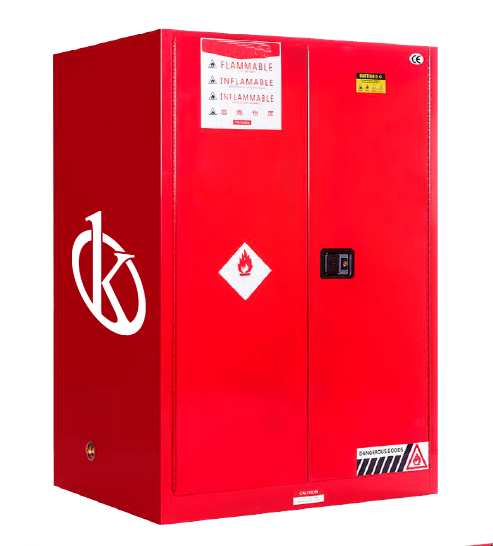
A safety cabinet is prefabricated equipment specially designed to carry out the storage of hazardous chemicals in mobile containers protecting their contents in case of fire, for a certain period of time and which meets the safety requirements of this ITC (International Trade Center) and the APQ Regulation (656/2017).
What is a liquid nitrogen container?

Nitrogen is a chemical element that makes up the majority of the atmosphere, approximately 78.03% by volume and 75.5% by weight. It is an inert gas, except when heated and combined with active metals such as magnesium or lithium. It also forms oxides of nitrogen, when combined with oxygen, and ammonia, when combined with hydrogen.
How should a tank of liquid nitrogen be handled?
Nitrogen is a chemical element found in group 15 and period 2 of the periodic table and, in addition, its atomic number is 7, that is, each atom of it has 7 protons in its nucleus. On Earth, making up 78% of the atmosphere, is molecular nitrogen, which is just two nitrogen atoms joined together.
Why is an optical surgical navigation system important in the O.R.?

Through technological advances in medicine, it allows health experts to reach levels of precision and safety using optical surgical navigation systems within the operating field, which are extended and assisted by computer, magnifying images, facilitating diagnosis, planning and execution of procedures.
What are the benefits of optical surgical navigation systems?
Through the use of optical surgical navigation systems, it allows the development of surgeries by means of real augmented technological simulation, which is characterized by sensory perception, adding visual content, as help guides to make them less invasive and show the role of the staff as comparative advantage over virtual reality.
What are the technologies used in a surgical navigation system?
A surgical navigation system is a medical team based on the principle of high-precision stereoscopic vision, and which has now become an essential team for the development of computer-assisted surgeries, as they are responsible for guiding the surgeon’s movements during surgery, showing the real-time position of each anatomical instrument and structure. This device allows the use of digital images in surgical procedures, thus providing surgeons with the opportunity to carry out preoperative planning and an effective use of the instruments during surgical procedures.
What are the parts of a surgical navigation system?
A surgical navigation system is an image-guided intraoperative location system, whose main function is to provide the surgeon with a real-time feedback of the location of the surgical instruments in relation to the anatomy of the patient. Therefore, it helps the planning and execution of surgical procedures in the operating theaters, guiding surgical instruments such as the electric scalpel. There are two types of navigation system: Optics and electromagnetic, both provide combined flexibility and efficiency in a space-saving design in the OR.
What is an optical surgical navigation system?
A surgical navigation system is a device that helps the planning and execution of surgical procedures in operating rooms, that is, it allows guiding surgical instruments such as the scalpel. It consists of instruments that are connected to screens by sensors with image methods. There are two types of navigation system: optical and electromagnetic, providing flexibility and efficiency combined in a design that takes up little space in the operating room.
Benefits of a Surgical Navigation System
Surgical navigation systems are modern medical equipment that allows visualizing the anatomy of the patient during a surgical procedure and accurately tracking the location of the instruments used in surgery. They reduce the traumatic risk and help in the surgical process.